Category

PROJECTS

Pediatric project – Nixi For Children

By PROJECTS
UN PROYECTO PEDIÁTRICO ESPECIAL

Un buen ejemplo de cuando un buen proyecto te atrapa desde el minuto 1. Así empezamos la reunión. cuando Tomàs Lóbez (CEO – Founder de Nixi For Children), nos propuso colaborar con su proyecto de realidad virtual para ayudar a pacientes pediátricos a entender mejor que pasaba en un quirófano y el proceso que conlleva someterse a una cirugía.

Antes de empezar con el proyecto, vieron que muchos niños entraban a quirófanos con muchos miedos y ansiedad, cosa que no ayudaba mucho al estado anímico y posterior recuperación. Eso les hizo empezar a trabajar en un proyecto que les ayudara a controlar esa ansiedad explicando previamente como iba a ser el proceso (pre-, cirugía y post-) de una manera muy sencilla facilitando su comprensión.

Mi_primera_visita_al_quirófano_Nixi_ALICIA_POZO

PREVIO A LA CIRUGÍA

Por nuestra parte, Olympus habilitó su showroom (simulación de un quirófano real a nivel de quipamiento médico y quirúrgico) para que rodaran esas escenas.

Muchas gracias tanto a Tomàs como a todo el equipo de Nixi For Children por darnos la oportunidad de colaborar en el proyecto con vosotros y por hacer lo que hacéis y como lo hacéis.

Os dejo el link a su web: WWW.NIXIFORCHILDREN.COM ¡No os lo perdáis!

SPECIAL PEDIATRIC PROJECT

A good example of when a good project catches you from minute 1. That’s how we started the meeting when Tomàs Lóbez (CEO – Founder of Nixi For Children) proposed us to collaborate with this virtual reality project to help pediatric patients to understand better what happens in an operating room and the process involved in undergoing a surgery.

Mi_primera_visita_al_quirófano_Nixi_ALICIA_POZO2

DURANTE LA CIRUGÍA

Before starting the project, they observed that many children enter in the operating room with many fears and much anxiety, which do not help to the mood and recovery. This fact made them start working on a project that would help children to control anxiety by previously explaining how the process (pre-, surgery and post-) was going to be in a simple way and facilitating their understanding.

From our side, Olympus enabled its showroom (simulation of a real operating room with medical and surgical equipment) to shoot those scenes. Many thanks to Tomàs and the entire Nixi For Children team for giving us the opportunity to collaborate with the project and for doing what you do and how you do it. Very appreciate to collaborate!

Mi_primera_visita_al_quirófano_Nixi_ALICIA_POZO3

DESPUÉS DE LA CIRUGÍA

Here you have the link: WWW.NIXIFORCHILDREN.COM

OR integration – Diakonie Clinic (Hamburg)

By PROJECTS
INTEGRACIÓN DE QUIRÓFANOS: ERGONOMIA Y DISEÑO

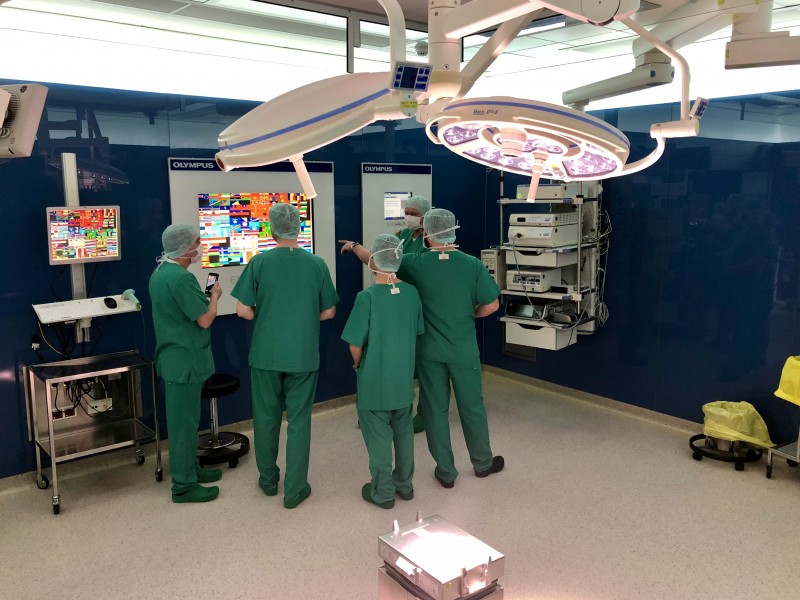
La Clínica Diakonie es uno de los centros de referencia que tiene OLYMPUS EUROPA en cuanto a integración de quirófanos y equipos médicos presentes dentro de ellos. Esta clínica está ubicada en Hamburgo y cuenta con quirófanos integrados desarrollados por el departamento de Systems Integration de Olympus llamado ENDOALPHA.

Un centro de referencia donde llevar a clientes para que vean como quedan las instalaciones una vez están finalizadas y en funcionamiento por los usuarios clínicos.

IMG_E1523

DENTRO DE QUIRÓFANO

Los equipos de imagen y energías están colgados en columnas mediante las cuales pasa todo el cableado necesario que llegan hasta los monitores, donde se visualizan todas las imágenes de endoscopia y en la pantalla táctil donde se controlan todos los parámetros de los equipos instalados.

Otra de las peculiaridades que tiene este hospital es la importancia que le dedican a las puertas de quirófano y a las paredes de los quirófanos ofreciendo una estética cuidada y de limpieza que ayuda tanto al paciente como a todo el personal sanitario que trabaja dentro de él.


OR INTEGRATION: ERGONOMY & DESIGN

The Diakonie Clinic is one of the reference centers that OLYMPUS EUROPE has in terms of OR integration and medical equipment. This hospital is located in Hamburg city and has integrated operating rooms developed by the Olympus SYSTEMS INTEGRATION department called ENDOALPHA.

A reference center where customers are carried out to see how the facilities are and how they do during procedures by clinical users.

The Image and Energy equipment are on boom arms through all the necessary wiring is connected to the monitors, where images are displayed. They have a touch screen where all the equipment parameters are controlled.

Another of the peculiarities of this hospital is the importance that they dedicate to the doors of the operating rooms and the glass walls with a careful and clean aesthetic that helps the patient and all the medical staff working within it.

IMG_E1513

PANEL TÉCNICO

4K ORs – H. Del Mar (Barcelona)

By PROJECTS
NUEVOS QUIRÓFANOS CON TECNOLOGÍA 4K EN HOSPITAL DEL MAR

El Hospital del Mar ha renovado dos de sus quirófanos con la última tecnología de imagen del mercado: 4K-UHD. En este proyecto se han actualizado tanto el aparataje médico-quirúrgico como la infraestructura de dichos quirófanos.

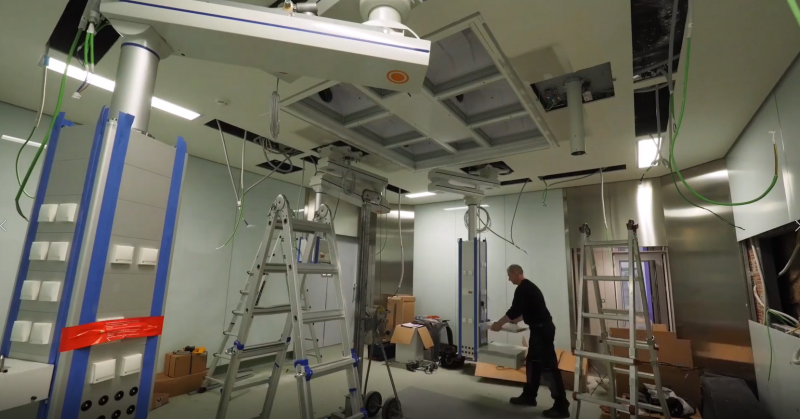
Por la parte de infraestructuras, se cambiaron las paredes por panelado de cristal, además del suelo y el techo. También, las estructuras que cuelgan del techo, como las columnas donde se ubican equipos médicos, las lámparas quirúrgicas y los portamonitores. La colocación suele centrarse entorno al paciente y a la mesa quirúrgica, en este caso, han sido dos columnas (una a la cabeza de la mesa quirúrgica destinada a anestesia con tomas de gases medicinales, y otra a los pies de la mesa destinada a equipos de cirugía). En los dos lados laterales a la mesa quirúrgica se ubican dos unidades de brazo portamonitor+lámpara quirúrgica.

Hospital del mar-Olympus (1)

PROCESO INFRAESTRUCTURA QUIRÓFANO


Hospital del mar-Olympus (2)

PROCESO PANELADO QUIRÓFANO


Hospital del mar-Olympus (3)

PROCESO COLUMNAS SUSPENDIDAS QUIRÓFANO

En las paredes, se ubicaron paneles técnicos donde se colocan los monitores de pared, uno grande de 50-60″ para la visualización de imágenes y otros dos pequeños de 22″ para el ordenador de enfermería y control del sistema de integración con pantalla táctil.
Respecto a los equipos médicos, se colocaron:

  • Procesador 4K-UHD con cabezal de cámara y ópticas 4K
  • Fuente de luz XENON
  • Insuflador de CO2
  • Grabador de imagen y vídeo
  • Generadores de energía monopolar, bipolar y sellador de vasos con energía ultrasónica + bipolar avanzada.
  • Unidad de control de equipos médicos
  • En los portamonitores, hay ubicados dos monitores de 31″ 4K-UHD para la visualización de imágenes quirúrgicas (principalmente de endoscopia). En uno de los dos quirófanos, se decidió cambiar uno de los dos monitores de 31″ por un monitor de 55″ aportando una magnificación en la visualización de la imagen.

Este proyecto ha sido realizado, coordinado y efectuado por el equipo de Systems Integration de Olympus Iberia.


NEW 4K TECHNOLOGY ORs IN HOSPITAL DEL MAR

Hospital del Mar has renovated two of its operating rooms (ORs) with the latest imaging technology on the market: 4K-UHD. In this project both the medical-surgical equipment and the infrastructure of these operating rooms have been changed.

For the infrastructure part, the walls were exchanged for the glass panel, in addition to the floor and ceiling. Also the structures that hang from the ceiling, such as the columns for the medical equipment, surgical lamps and monitor holders are located. The placement is usually centered around the patient and the surgical table, in this case there have been two columns (one head of the surgical table for anesthesia taking of medical gases, and another at the foot of the table for surgical equipment). On the two lateral sides of the surgical table there are two units of monitor arm + surgical lamp. On the walls are placed technical panels where are the wall monitors, one large monitor 50-60″ for the visualization of images and other two small monitors 22″ for the nursing team and medical control device with a touch screen.

Regarding medical equipment, the following list will be placed:

  • 4K-UHD processor with camera head and 4K optics
  • XENON light source
  • CO2 insufflator
  • Image and video recorder
  • Monopolar, bipolar and vessel sealant generators with ultrasonic + advanced bipolar energy.
  • Medical equipment control unit
  • In the monitor holders are two monitors of 31″ 4K-UHD for the visualization of surgical images (mainly endoscopy). In one of the ORs, we change one monitor 55″ instead of 31″ contributing a magnification in the visualization of the image.

This project has been carried out and coordinated by Integration Systems team from Olympus Iberia.

Hospital del mar-Olympus (3)

VISTA FINAL DEL QUIRÓFANO

OR Ergonomy: Booms&Lights – H. Ramón y Cajal (Madrid)

By PROJECTS
NUEVAS ESTRUCTURAS: COLUMNAS, LÁMPARAS Y BRAZOS PORTAMONITOR PARA LOS NUEVOS QUIRÓFANOS INTEGRADOS

Cuando se realiza un nuevo bloque quirúrgico, las primeras estructuras que se instalan en los quirófanos intregados son las columnas, normalmente una para anestesia y otra para equipamiento, las lámparas quirúrgicas y los brazos portamonitor. En esta primera etapa del proyecto se explica como configurar estas estructuras.

  • Para la configuración de la columna de anestesia hay que saber los gases que se necesitan para su conexión con el equipo de anestesia: O2, CO2, N, VAC… así como las tomas de electricidad y tomas de tierra.
booms-lights-alicia-pozo (1)

INSTALACIÓN COLUMNAS

  • Para la configuración de la columna de equipamiento hay que saber las conexiones de vídeo que se van a integrar para conectar a los equipos (cámaras, ecógrafos…) así como las señales que se van a enviar a los monitores (DVI, HDMI, SDI, SVIDEO…) Aunque actualmente la que más se está utilizando es la fibra óptica. Además de las tomas de electricidad, de gases (para el insuflador), tomas de tierra y de datos.
  • Para la configuración de las lámparas quirúrgicas se necesita saber: rango de temperatura de color, luxes, número de LEDs, diámetro de foco, etc.
booms-lights-alicia-pozo (3)

LÁMPARA QUIRÚRGICA

  • Para la configuración del portamonitor se necesita saber la señal de vídeo de entrada que tienen los monitores así como su tamaño (normalmente de 26-32 pulgadas +/-).
booms-lights-alicia-pozo (5)

ESTRUCTURA LÁMPARA+PORTAMONITOR


NEW STRUCTURES: BOOMS, LIGHTS AND PORTAMONITOR ARMS FOR THE NEW INTEGRATED OR

When a new surgical block is made, the first structures that are installed in the operating rooms are the booms, usually one for anesthesia and another for equipment, surgical lights and portamonitor arms. This first stage of the project explains how to configure these structures:

  • For the configuration of the anesthesia boom, it is necessary to know the gases needed for connection with the anesthesia equipment: O2, CO2, N, VAC… as well as the electrical outlets and ground outlets.
  • For the configuration of the equipment boom, it is necessary to know the video connections that will be integrated to connect the equipment (cameras, echographs …) as well as the signals to be sent to the monitors (DVI, HDMI, SDI, SVIDEO …) Although currently the most used is fiber optic. In addition to the electricity, gas (for the insufflator), ground and data plugs.
  • For the configuration of the surgical lamps you need to know: color temperature range, luxes, number of LEDs, diameter of focus, etc.
  • For the configuration of the portamonitor you need to know the input video signal that the monitors have as well as their size (usually 26-32 inches +/-).
booms-lights-alicia-pozo (4)

LÁMPARA+PORTAMONITOR

OR Surgical Lighting – H.Clinic (Barcelona)

By PROJECTS
¿CÓMO FUNCIONA LA ILUMINACIÓN AMBIENTE EN QUIRÓFANO?

Dentro de un quirófano integrado uno de los circuitos a nivel de infraestructura que se puede controlar son los sistemas de iluminación. Este sistema es importante debido a la actividad que se va a realizar en el quirófano, ya que de esta manera, se optimizan las luces y se activa el modo de trabajo que corresponda.

La tecnología empleada es LED y mediante un monitor pequeño táctil ubicado en el panel de pared, se puede encender y apagar, regular la intensidad de luz y programar diferentes modos de manera que se seleccione con el que se quiere trabajar y las luces automáticamente se acondicionen a la programación de ese modo.

A continuación se muestran varios ejemplos de como optimizar la luz para cada actividad en el quirófano:

  • MODO CIRUGÍA ABIERTA
  • MODO ENDOSCOPIA
  • MODO LIMPIEZA
  • MODO PRE-CIRUGÍA
p1012538

MODO PRE-CIRUGÍA


p1012546

MODO ENDOSCOPIA


p1012549

MODO LIMPIEZA


HOW DOES SURGICAL LIGHTING WORK IN OR?

Inside an integrated operating room one of the main circuits of infrastructure is the lighting system. This system is important for the activity that is going to be performed in the operating room, since this way the lights are hidden and the corresponding working mode is activated.

The technology used is LED by means of a small touch monitor located on the wall panel, you can turn it on and off, regulate the light intensity and program different modes so that you select which one you want to work with and the lights automatically are programming in that way.

Here are several examples of how to optimize light for each activity in the operating room:

  • OPEN SURGERY MODE
  • ENDOSCOPY MODE
  • CLEANING MODE
  • PRE-SURGERY MODE

HBP OR – H. Clinic (Barcelona)

By PROJECTS
IDENTIFICACIÓN Y CARACTERIZACIÓN DE LA DOTACIÓN, REQUERIMIENTOS DE INSTALACIONES Y CONDICIONANTES DEL USO DEL EQUIPAMENTO ELECTROMÉDICO PRESENTE EN UN QUIRÓFANO DE CIRUGÍA HEPATOBILIAR-PANCREÁTICA

Una de las partes más importantes de un hospital son los quirófanos o salas operatorias, donde se llevan a cabo intervenciones quirúrgicas.  Dentro de las distintas especialidades  se encuentra el quirófano de cirugía hepatobiliar-pancreática, en el que se practican todo tipo de operaciones que afectan al hígado, órgano fundamental en la actividad metabólica del organismo y páncreas. Debido a la importancia de estas intervenciones, tanto la instalación como el equipamiento debe estar cuidadosamente estudiada y detallada para realizar los procedimientos quirúrgicos de la mejor manera posible, es por ello que se requiere de una caracterización completa de este tipo de salas tanto a nivel de infraestructuras como de los dispositivos y equipos electromédicos que se emplean para realizar una correcta remodelación.

Resumen del proyecto

  1. Introducción
  2. Objetivos
  3. Análisis de mercado
  4. Ingeniería de diseño
  5. Ingeniería de detalle
  6. Viabilidad técnica
  7. Viabilidad económica
  8. Solución técnica y finaciera del proyecto
  9. Conclusiones

Objetivos del proyecto

  • Identificar todos los componentes de un quirófano. Conocer su utilidad, posición y función dentro de éste.
  • Caracterizar los equipos electromédicos que hay presentes en él, con su posterior ficha técnica. Descripción, proveedor, funcionamiento, conexiones, mantenimiento, uso y posición.
  • Comparar equipamientos antiguos con otros más nuevos del mercado. Aspecto a considerar debido a la futuras remodelaciones del quirófano hepático, una primera fase de actualización a tecnología 3D en 2014 y para renovarlo íntegro en 2015.
  • Presentar una solución técnica y financiera del proyecto.

ANTES/BEFORE:

clinic1

Vista OR antes de la remodelación


clinic2

Caracterización equipamiento OR

DESPUÉS/AFTER:

OLYMPUS DIGITAL CAMERA

Vista OR después remodelación


IDENTIFICATION AND CHARACTERIZATION OF THE SUPPLY, REQUIREMENTS OF FACILITIES AND CONDITIONING OF THE USE OF THE ELECTROMEDICAL EQUIPMENT PRESENT IN A QUIROPHAN OF HEPATOBILIAR-PANCREATIC SURGERY

One of the most important parts of a hospital is operating theaters or operating rooms, where surgical interventions are performed. Within the different specialties is the hepatic operating room, in which all kinds of operations are performed that affect the liver, a fundamental organ in the metabolic activity of the organism and pancreas. Due to the importance of these interventions, both the installation and the equipment must be carefully studied and detailed to perform the surgical procedures in the best possible way, which is why a complete characterization of these types of rooms is required at the level of Infrastructures such as medical devices and equipment that are used to make a good renovation.

Project summary

  1. Introduction
  2. Objectives/goals
  3. Market analysis
  4. Design engineering
  5. Detail engineering
  6. Technical feasibility
  7. Economic viability
  8. Technical and financial solution of the project
  9. Conclusiones

Project objectives

  • Identify all components of an operating room.
  • Know their utility, position and function within it.
  • Characterize the electro-medical equipment that is present in it, with its technical data sheet. Description, supplier, operation, connections, maintenance, use and position.
  • Compare old equipment with new ones on the market. Aspect to consider due to the future remodeling of the hepatic surgery, a first phase of updating to 3D technology in 2014 and to renew it in full in 2015.
  • Present a technical and financial solution of the project.